
Why God’s Justice Knows No Borders: A Deep Dive into the Sovereignty of Amos
What if the justice of God has nothing to do with whether a person acknowledges Him, and everything to do with the simple reality that we live in His world?
For many students of the Bible, the concept of God is often relegated to that of a "personal defender"—a deity who looks out for "His people" and acts as a divine shield against their enemies. In the modern world, we find comfort in a God who is on our team. But if we are to move past a surface-level reading of Scripture, we must confront a radical truth revealed in the minor prophets: God is not a tribal mascot. He is a global Sovereign.
In this Book of Amos study, we explore why divine justice isn’t a "members-only" club and why every nation, government, and individual falls under the absolute jurisdiction of the Creator.
Before we dive deep, if you want to follow my personal process for studying these difficult passages, you can grab my free guide here:
The "Local Deity" Mindset: A World of Tribal Gods
To grasp the radical nature of the message of Amos, one must first understand the religious landscape of the Ancient Near East (ANE). In the ancient world, the concept of a "universal" God was virtually non-existent outside of the Hebrew revelation. Instead, the world was governed by what scholars call a "Local Deity" mindset.
Territorial Jurisdiction in the Ancient World
In the Ancient Near East, gods were viewed as local patrons. They were believed to have power and authority only within specific geographical borders or over specific ethnic groups. Chemosh was the god of the Moabites; Milcom was the god of the Ammonites; Dagon belonged to the Philistines. The strength of a god was often measured by the military success of his people. If a nation was conquered, it was assumed their god was either weak or had been defeated by a more powerful local deity.
The common theology of the day was simple: "My god protects me; your god protects you."
If a nation like Moab committed an atrocity against a nation like Edom, the people of Israel would never have expected their God, YHWH, to care. Why would He? Those weren't His people. Those weren't His lands. In the minds of the ancients, justice was a domestic, tribal issue. If you didn't worship a specific god, you were effectively "unsubscribed" from that god's laws and his wrath. This regional view of divinity allowed for a world where atrocities could be committed with perceived impunity, provided the local god was satisfied.
Note: If you prefer to watch a visual breakdown of this teaching, you can view the video version of this study on YouTube: Why God’s Justice Knows No Borders.
The Prophet Amos: A Disruption of the Status Quo
This is the framework that the prophet Amos was sent to shatter. Amos didn't just step onto the scene to speak to Israel; he spoke on behalf of a God who holds the entire world accountable. He presented a vision of the Sovereignty of God that transcended political borders and religious affiliations.
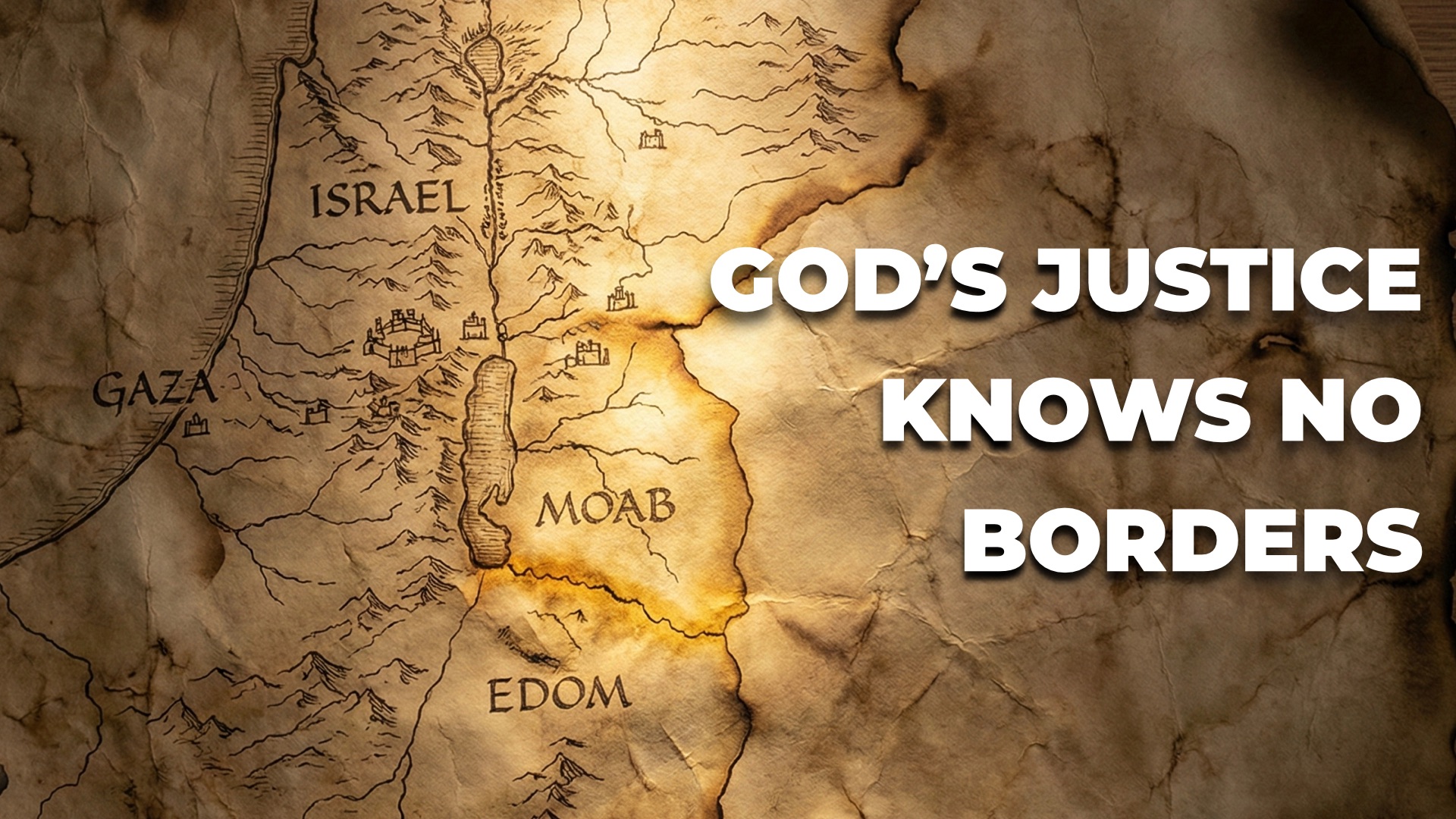
When we open Amos chapters 1 and 2, we see a series of oracles against the nations surrounding Israel: Damascus, Gaza, Tyre, Edom, Ammon, and Moab. What makes these oracles revolutionary is that Amos addresses nations that did not acknowledge YHWH as God, did not possess the Mosaic Law, and did not offer sacrifices in the Temple.
The Pattern of the Eight Oracles
Amos uses a brilliant rhetorical strategy. He begins by condemning the enemies of Israel. As he moves from Damascus to Gaza and Tyre, the Israelites listening would have cheered. They loved the idea of God judging their enemies. Amos was confirming their bias: God is our defender. But then, Amos pivots. He moves closer and closer to home, eventually turning the spotlight of Biblical Justice onto Israel itself. By the time he finishes, he has established that no one is exempt from the moral standards of the Creator.
Case Study in Universal Justice: Amos 2:1 and the King of Edom
Perhaps the most striking evidence of this universal justice is found in Amos 2:1. God declares a sentence of punishment against the nation of Moab. If we were following the "tribal" mindset, we would expect the crime to be an attack on Jerusalem or a desecration of the Jewish Temple. We would expect God to be angry because Moab hurt His people.
But the text says something else entirely:
"Because he burned to lime the bones of the King of Edom."
Think about the weight of that statement. Moab committed a horrific act of desecration against Edom—a nation that was a historical enemy of Israel. Neither Moab nor Edom recognized the God of Israel. They were pagan nations engaged in a pagan conflict. There was no "religious" reason for YHWH to be involved.
And yet, YHWH says, "I saw it. It was an atrocity. And I will not let it stand."
The Ethical Jurisdiction of God
This introduces us to the concept of Ethical Jurisdiction. God is not a God of justice only when His people are the victims. He is a God of justice when anyone is the victim. He doesn't just punish "the bad guys" for hurting "the good guys." He punishes the perpetrator for violating the inherent dignity of the human person. This teaches us that God’s moral standards are not restricted to those within a covenant. He assumes that a moral obligation exists between all human beings, regardless of their creed, culture, or century. In the eyes of God, there is a universal law of human decency that no nation is allowed to cross.
The Reality of Absolute Sovereignty
This realization leads us from the courtroom of justice to the throne of sovereignty. When God addresses nations that don't worship Him, He is asserting a claim that is as bold today as it was 2,700 years ago. He is essentially saying: "It doesn't matter if you don't recognize Me. I am the God of the universe. You live in My world."
You Cannot "Opt Out" of the Creator
In our modern, secularized society, we often treat religious authority as something we "opt into." We choose a religion like we choose a subscription service. If we don't like the rules, we simply cancel our membership and assume we are no longer under that authority. We think that by ignoring God, we can effectively remove ourselves from His jurisdiction.
Amos reveals that divine authority is not a preference; it is a reality. Because God is the Creator of all nations and all people, He is the rightful Sovereign over all creation. Whether a nation recognizes Him or not, they are operating on His stage, breathing His air, and ultimately, they will stand before His bench. This is an uncompromising claim of absolute divine authority that knows no borders. The Sovereignty of God means that His rules apply even to those who claim He doesn't exist.
Global Accountability in a Modern World
If we accept the testimony of Amos, we must accept a heavy truth: on a global scale, God holds every people group, every government, and every corporation accountable. Biblical Justice is not limited to the pages of ancient history; it is the current operating reality of our world.
It does not matter if a government claims to be "secular" or if a multi-national entity says they do not answer to a "higher power." The Book of Amos shows us that God’s judicial authority is not something you can "unsubscribe" from or "opt out" of. It is the fundamental fabric of the universe.
- He sees the marginalized: In nations where His name is never spoken, God still hears the cry of the oppressed.
- He hears the cry of the victim: In conflicts that have nothing to do with religion, God is present as the advocate for the wounded.
- He holds the powerful to account: Even when an earthly entity is more powerful than any human court, they are not more powerful than the Creator.
God is not a "national" god; He is the Global Advocate for Justice. This means that as believers and students of the Word, we cannot be indifferent to atrocities simply because they "aren't our problem." If God is not indifferent, we cannot be either. We must align our hearts with the God who sees every bone burned to lime and every injustice committed in the dark.
Bringing It Home: Personal Responsibility
It is easy to talk about "nations" and "governments" and feel as though we, as individuals, are off the hook. We might think, "I’m not the one making the laws or leading an army. I’m just trying to get through my week."
But the justice of God does not stop at the palace doors or the city gates. In the latter chapters of Amos, God turns His gaze directly to the individuals within the nation. He speaks to the wealthy who were "trampling on the needy" and the merchants who were using dishonest scales in the marketplace to cheat the poor. He addresses the comfortable who were indifferent to the ruin of their neighbors.
The message is clear: Justice is not just a corporate responsibility; it is a personal one. It is about how you treat your neighbor, how you conduct your business, and how you respond when you see someone being treated unjustly in your own community. We cannot claim to worship the Sovereign of the universe while ignoring the ethical obligations He has placed on us as inhabitants of His world.
Move Past the Surface of Your Bible Study
The Book of Amos is often avoided because it feels filled with strange names and distant history. But when you apply a structured method to your study, these distant histories become immediate warnings and profound comforts. This is why I am so passionate about helping you move from a surface-level reading to an in-depth study of the text.
If you find yourself struggling to find this kind of depth when you open your Bible, you aren't alone. Many people get stuck because they lack a repeatable process. To help you overcome this, I’ve put together a specialized resource.
In this guide, "The 5 Steps I Follow Every Time I Study a Passage of Scripture," I outline the exact process I use to uncover original meanings and extract timeless principles—like the universal jurisdiction of justice we discussed today. If you want to study with clarity, structure, and spiritual depth, you can download it for free above.
Conclusion: A Warning and a Comfort
Is Amos just an old book of prophecies? No. It is a warning to every entity that thinks it is above the law. And it is a comfort to every victim who thinks they have been forgotten. God is a God of justice. Period. He doesn't need our permission to be the Judge, and He doesn't need us to recognize Him as "our God" to enforce His standards. Whether it’s an ancient king burning bones or a modern system crushing the poor—God sees it, and God will hold it to account.
As you go about your week, remember: You are operating on His stage. You are breathing His air. You live in His world. Let that truth change the way you see yourself, your neighbor, and the world around you.
God bless,
Dr. Mario Escobedo
Your Bible Study Mentor
