When Strength Isn’t Enough: The Hidden Tragedy of Samson at the Gates of Gaza
Have you ever performed a massive feat of strength—spiritual, professional, or relational—only to realize it was actually a "walk of shame" in disguise? It’s a specific kind of tragedy that only happens to incredibly talented people. It is the moment you realize that your talent has taken you to a place where your character simply cannot sustain you.
In Judges 16:1-3, we encounter one of the most physically impressive moments in the life of Samson. We see a man ripping the massive gates of a Philistine stronghold right out of the ground. On the surface, it looks like a superhero victory. But as Your Bible Study Mentor, I want to take you beneath the surface. When we look at the original Hebrew context and the literal topography of the land, we discover that this wasn't a mission of liberation; it was a desperate act of self-preservation. In fact, every "victory" in Samson's story is actually a self-preservation tactic that left the nation of Israel still oppressed and unchanged.
In this study, we are going to explore why how vigorously you guard your character is more important than how impressively you use your gifts.
(I also recorded a deep-dive teaching on this very topic. If you would like to watch or listen to the full-length podcast episode, you can find it here: Watch the Full Teaching)
1. The Geography of a Compromise (Judges 16:1)
The text begins with a chillingly simple sentence: "Samson went to Gaza, and there he saw a prostitute, and he went into her."
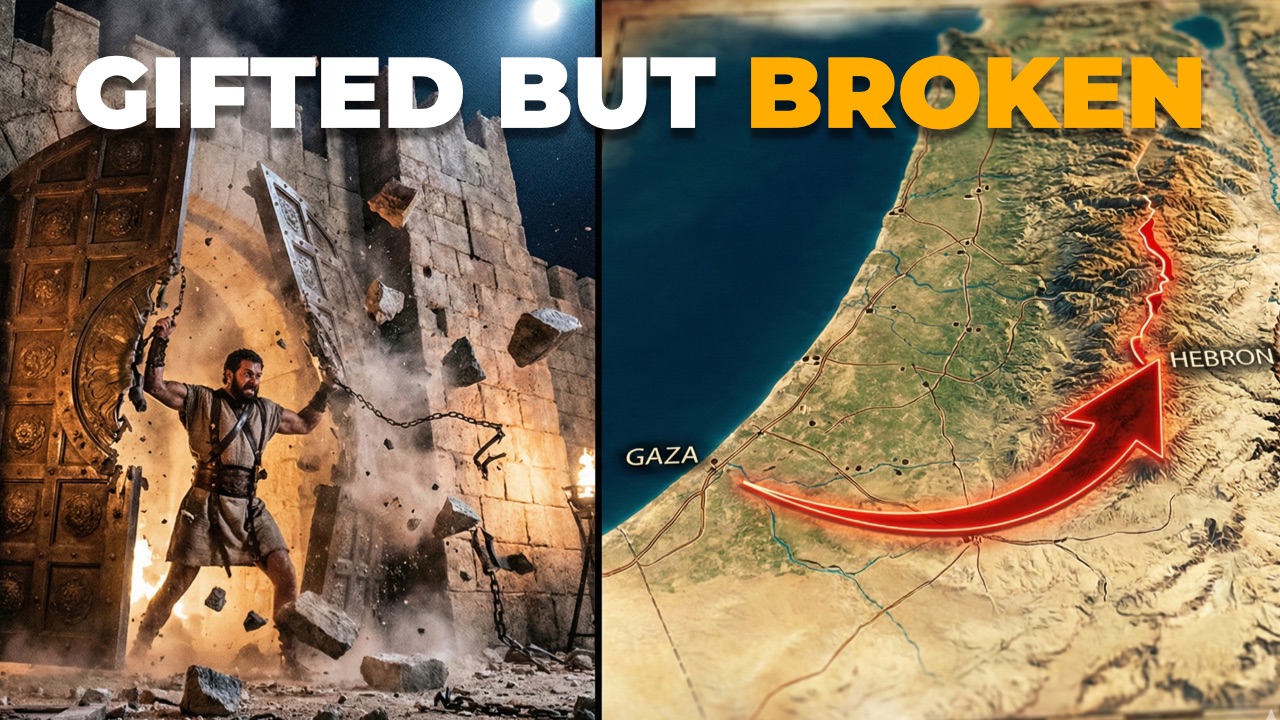
To understand the spiritual weight of this, we have to look at the map. Samson’s home region was near Zorah. Gaza, however, was the southernmost city of the Philistine Pentapolis. It was roughly 35 to 40 miles away from his home region. Why does this distance matter? Because in the Bible, locations are characters.
The "Incognito" Zone
As a student of the Word, you must learn to ask the text questions. Why would Samson travel nearly 40 miles for this "escapade"? I suggest that Samson was looking for a place to hide. He wanted to hide what he was doing from his own people, and he wanted to hide who he was from the Philistines. Gaza was a place where Samson felt he could indulge his passions without the burden of his calling. Hey, what happens in Gaza stays in Gaza, right? But here is an insight I want you to consider: You can travel 40 miles to hide from your calling, but you cannot outrun your character.
2. The False Security of the Gates (Judges 16:2)
The Gazites find out Samson is in town. They surround the city and set an ambush at the city gate. They decide to wait until dawn to kill him. Why didn't they attack him immediately? Likely, they wanted the element of surprise and the advantage of numbers in an open space. But more importantly, they trusted their gates.
The Architecture of Authority
In the Ancient Near East (ANE), the city gate was the heart of the city’s security and legal system. It was the Seat of Authority. It was where the elders sat, where business was conducted, and where the city's power was anchored. To the Philistines, the gate was impenetrable. They believed that as long as those gates were barred, Samson was a prisoner of his own lust. They were so confident in their physical security that they might have even gone to sleep, planning to deal with him in the light of morning. The Philistines thought the gates kept Samson in, but Samson was about to show them that their authority was an illusion.
3. The 40-Mile Walk of Shame (Judges 16:3)
At midnight, Samson arises. He doesn't just open the gates; he dismantles them. He rips the two posts, the bar, and the doors out of the foundation. He hoists them onto his shoulders and begins a trek that defies human explanation.
Elevation and Ego: Uphill to Hebron
The Bible tells us he carried them to the top of the hill that faces Hebron. If you use your Bible Atlas, you will see a detail that most readers skip over: Gaza is on the coastal plain at sea level. Hebron is located in the central highlands at an elevation of approximately 3,000 feet. Samson didn't just walk 40 miles; he walked 40 miles uphill while carrying a load that likely weighed several tons. It was an act of staggering ego. He performed a miracle not to save Israel, but to save face because he got caught where he shouldn't have been.
4. The Mentor’s Process: How to Study Like a Scholar
I want to show you how I arrived at these insights so you can do the same. As a "Self-Feeder," you don't need a PhD; you need the right habits. When I study a passage like Judges 16, I follow a specific 3-step process:
- Step 1: Check the Coordinate. When you see a city name (Gaza, Hebron), don't skip it. Open your Bible Atlas. Look at the terrain. Is it uphill? Is it near water? This turns 2D text into 3D reality.
- Step 2: Define the Theological Function. Don't just look up synonyms for Hebrew words. Ask: "What did a Gate mean to an ancient person?" When you realize it meant Authority, the story changes from a feat of strength to a spiritual confrontation.
- Step 3: Audit the Motivation. Ask the most important question: "Who does this miracle serve?" If the miracle only serves the person performing it, it is a warning, not a victory.
5. Four Critical Lessons for the Modern Leader
As we transition from the text to our lives, we must allow the Word to audit our hearts. Samson’s life serves as a "Pattern Interrupt" for our own spiritual habits.
I. Character vs. Giftedness
How vigorously you guard your character is more important than how impressively you use your gifts. Samson was "anointed but unstable." He could kill a lion, but he couldn't control a look. He could carry a gate, but he couldn't carry a secret. We must prioritize our private devotion over our public demonstration.
II. The "Skyscraper" Principle
Think of your gift as a building and your character as the foundation. You can build a massive skyscraper of talent, but if your character foundation is thin, that building is eventually going to implode. A person whose character is too weak to support the weight of their gift will eventually destroy themselves. Never build your platform higher than your foundation can support.
III. Gifts Don’t Grant Immunity
Being gifted by God does not make you immune to character flaws. Sometimes talented people fail to see their own rot because all they (and others) see is the magnitude of their gift. They assume God's power through them equals God's approval of them. Do not mistake God's mercy for His endorsement of your hidden patterns.
IV. Leaving a Bad Impression
You can do impressive things and still leave a bad impression. Samson left a legacy of "What could have been." We are called to leave an impression of Christ’s character, not just a highlight reel of our own abilities. Grow the person behind the gift.
6. Recommended Tools for Your Library
Modeling the study process requires the right tools. If you want to see the "crinkles" on the map and understand the uphill trek to Hebron for yourself, I recommend these resources:
- Holman Bible Atlas (Print Edition): Available on Amazon. This is a beautiful, hardcover resource with glossy diagrams.
- Holman Bible Atlas (Digital Edition): Available on Logos. This is what I use to quickly cross-reference locations during my study.
- Logos Bible Software: Get a Free 60-Day Trial. It is the gold standard for in-depth Bible study.
Final Commission: Audit Your Foundation
My friend, God will honor your hunger for His Truth. You are not just a reader; you are a student. This week, ask yourself: "Am I using my God-given strength to build His Kingdom, or am I just using it to get myself out of the messes I've created?"
Take the next step in your journey toward becoming a "Self-Feeder."